
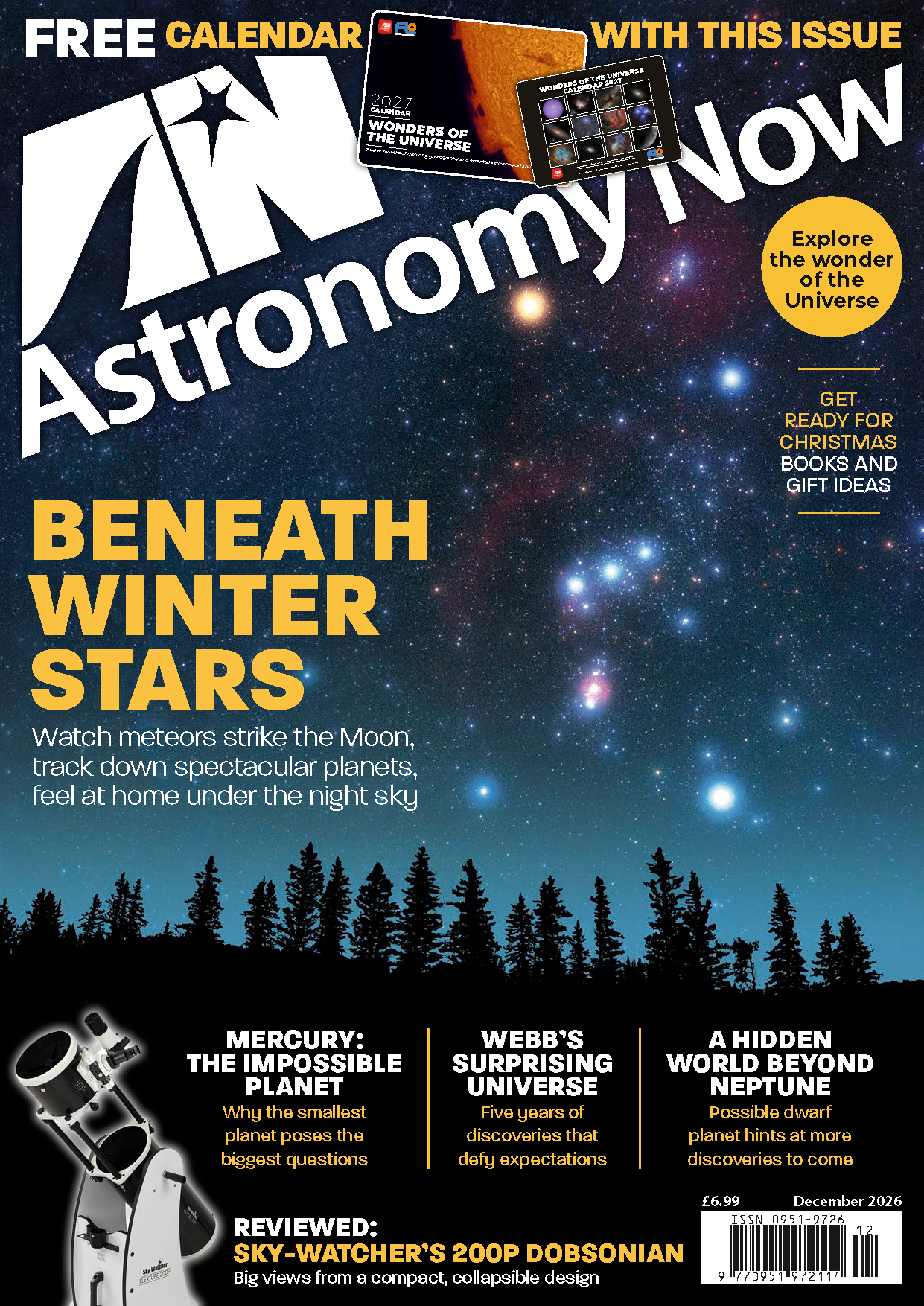
AN December 2026

£6.99
FREE with this issue – the 2027 Wonders of the Universe calendar. Explore the cosmos all year, with a spectacular astronomical image for every month.
Mercury is the smallest planet in the Solar System, yet it has an enormous iron core and harbours ice in craters close to its poles. How did a planet like this come to be? In the December issue of Astronomy Now, Colin Stuart explores the mysteries of the world he calls “the impossible planet”.
More details below…
Five years after the James Webb Space Telescope launched, its discoveries are still catching astronomers by surprise. Elizabeth Howell picks out some of the biggest surprises from Webb’s first five years, from planets around other stars to galaxies in the early Universe.
Elsewhere, we look at all the ways the Universe could kill us. From asteroid impacts to exploding stars, Colin Stuart weighs up the dangers in this month’s Big Question. And if after reading it keeps you up at night, you might as well go stargazing.
Our guide to the December sky will help you make the most of the long winter nights, whether you are just starting out or have been observing for years. Join Stuart Atkinson for a Christmas tour of targets you can find with a first telescope, or try a different kind of meteor watch. Tony Cook explains how to look for brief flashes on the Moon as Geminid meteoroids strike its surface.
In the news, the Vera C. Rubin Observatory has helped uncover a possible new dwarf planet in the outer Solar System, and we look at how a world hot enough to have a molten surface could hold on to an atmosphere.
Steve Ringwood puts the Sky-Watcher Skyliner 200P FlexTube Dobsonian through its paces and rounds up new astronomy gear for Christmas. There is also practical advice for getting started in astrophotography and a look at how astronomers work out what an exoplanet’s atmosphere is made of.
From the ice in Mercury’s shadowed craters to the galaxies Webb has glimpsed in the early Universe, there is plenty to discover in the December issue of Astronomy Now, including wonders you can see for yourself under the winter sky. And with your free 2027 Wonders of the Universe calendar, there is a spectacular new view of the cosmos to look forward to every month.
| Weight | 0.275 kg |
|---|---|
| Dimensions | 0.4 × 21 × 29.7 cm |
Related products


Back Issues

Magazines

Back Issues

Back Issues

Back Issues

Back Issues

Back Issues
Back Issues