
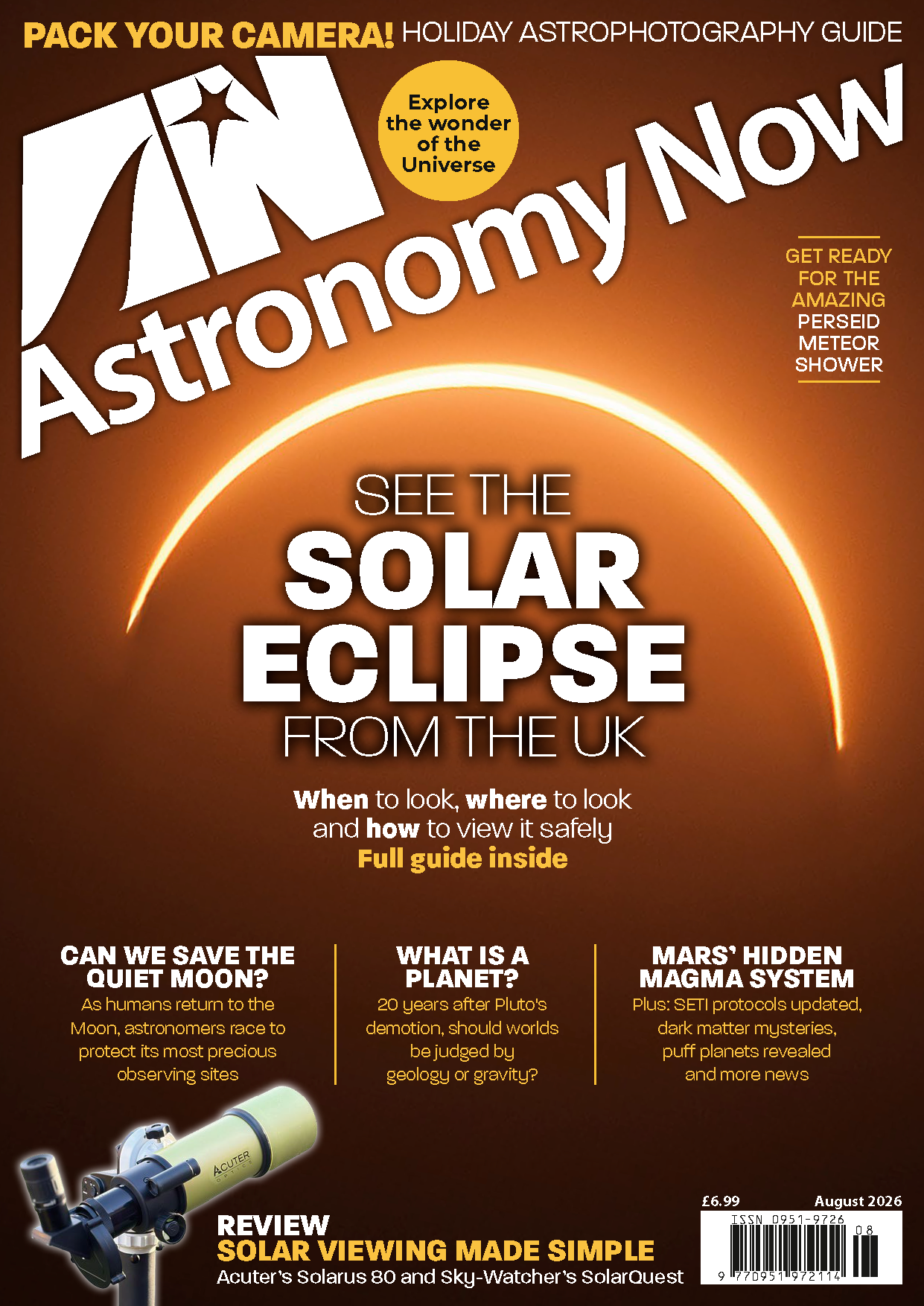
AN August 2026

£6.99
The August 2026 issue of Astronomy Now is led by the biggest UK solar-eclipse event for many years. On 12 August, a deep partial eclipse of the Sun crosses the country, with much of the UK seeing around 90 percent of the Sun covered by the Moon. Our full guide explains when to look, where the eclipse will be best seen, what to expect from your location and, most importantly, how to view it safely. Only in the August issue of Astronomy Now.
And that is only the beginning of a remarkable month for skywatchers.
More details below…
Two weeks later comes a dramatic partial eclipse of the Moon, while the annual Perseid meteor shower enjoys especially favourable conditions, with no moonlight to spoil the show.
Also in this issue, we mark 20 years since Pluto’s demotion and ask what really makes a planet. Should a world’s status be decided by its orbit and gravitational dominance, or by its geology and character as a world? It is a debate that reaches far beyond Pluto itself.
We also look to the Moon’s future and ask whether lunar astronomy can survive the human return. The lunar far side could be astronomy’s greatest refuge from Earth’s radio noise, but as landers, bases, satellites and rocket debris begin to crowd the Moon, astronomers are racing to protect its most precious observing sites.
In the news pages, discover evidence that Mars once hid a vast underground magma system, why the Bullet Cluster still matters in the dark-matter debate, how SETI researchers are updating the rulebook for first contact, and why two newly confirmed planets are lighter than candy floss.
Plus, Colin Stuart explains how stars form, Martin Howe shows how to take astrophotos on holiday with a digital camera, Jamie Gregory-Macdougall tests Acuter’s Solarus 80 and Sky-Watcher’s SolarQuest, Nik Szymanek reviews new AI-assisted noise-reduction software, and our observing section guides you through the August night sky, from Vulpecula’s Dumbbell Nebula to the month’s eclipses, planets, comets and deep-sky highlights.
Order your copy of the August 2026 issue of Astronomy Now today.
| Weight | 0.275 kg |
|---|---|
| Dimensions | 0.4 × 21 × 29.7 cm |
Related products

Back Issues
Back Issues
Back Issues

Back Issues

Back Issues
Back Issues
Back Issues
Back Issues